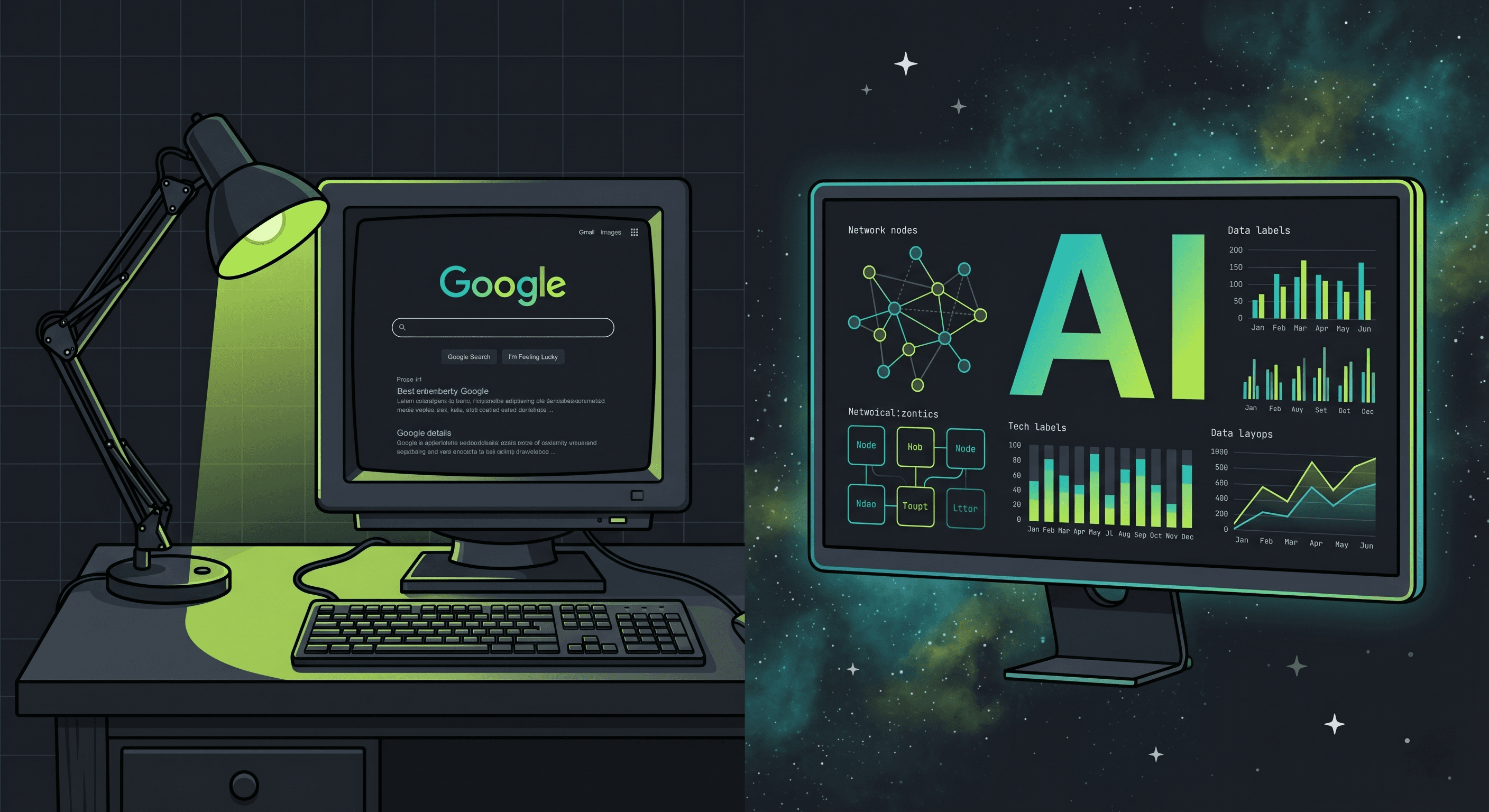
Here's what's really happening, and it's way bigger than the acronym chaos suggests: AI isn't just changing search. It's becoming the operating system for your entire digital ecosystem.
Think about the actual customer journey in 2025. A prospect starts with a query in ChatGPT or Perplexity. They land on your site. A chat agent answers technical questions. They get a personalized email sequence based on their browsing behavior. Your marketing automation uses AI to score and route the lead. Your data enrichment tools fill in company details. If you're B2C, recommendation engines suggest complementary products. If you're B2B, AI surfaces relevant case studies based on industry and use case.
AI isn't just the first touchpoint anymore. It's every touchpoint.
And all those acronyms (GEO, AEO, LLMO, SXO) are describing isolated pieces of a much larger strategic shift. They're tactics, not the strategy. We've been so focused on "how do we show up in AI search results?" that we've missed the bigger question: How do we architect our entire digital presence so AI systems can interact with us effectively across the customer lifecycle?
That's what AIO should really mean. Not "SEO for AI." Not "answer optimization." AI Optimization as an enterprise-level strategy for operating in an AI-mediated world.
The Alphabet Soup: Tactics in Search of a Strategy
Let's map the current landscape. SEO is the foundation, optimize to rank in traditional search results through content, technical hygiene, and authority signals. GEO focuses on being cited in AI-generated search outputs like Google AI Overviews, ChatGPT Search, and Perplexity. AEO is about winning the direct answer slot when AI systems respond to queries. LLMO ensures LLMs represent your brand accurately and cite you correctly when they generate content about your space. SXO tries to bridge visibility with on-site experience, originally about post-click behavior but now expanding into AI contexts. AISEO and AISO are generic umbrella attempts for "SEO adapted to AI search."
Google's Official AI Overview Documentation
Now let's add the tactics that aren't getting acronyms yet, but should be part of the conversation. Conversational AI optimization means ensuring chat agents on your site can answer customer questions accurately, escalate appropriately, and move people through the funnel. Personalization engine optimization is about structuring data and content so AI-powered personalization systems can deliver relevant experiences across email, web, and product recommendations. Data enrichment optimization focuses on organizing your data architecture so AI systems can extract, enrich, and activate customer information across your stack. Agentic AI readiness means preparing for AI systems that don't just inform decisions but execute them, researching options, comparing vendors, booking meetings, negotiating terms.
See the pattern? We've been treating these as separate problems when they're all part of the same architectural challenge.
What All These Terms Really Mean
Strip away the jargon and every single one of these is asking the same core questions. Can AI systems find our content and data? Can they understand what we offer and who we serve? Do they trust us enough to cite, recommend, or act on our behalf? Can they interact with our digital properties effectively? Are we structured to work with AI across discovery, evaluation, conversion, and retention?
The acronym explosion is a symptom of fragmented thinking. Teams are optimizing for AI search over here, implementing a chatbot over there, running personalized email campaigns somewhere else, and treating them all as independent projects. But in an AI-mediated ecosystem, they're not independent. They're interconnected layers of the same strategic imperative: make your digital presence AI-native across the entire customer journey.
Why "Answer Engine Optimization" Misses the Point
AEO has gained traction because it's intuitive. AI answers questions, so optimize for answers. But that framing is already too small.
AI systems are rapidly moving beyond Q&A into multi-step workflows. They're not just answering "What's the best project management tool?" They're researching your team size, comparing platforms based on specific criteria, reading reviews from similar companies, checking integration compatibility, and eventually (through agentic workflows) they'll book demos and negotiate contracts.
For B2B companies with long sales cycles, AI is becoming the research assistant that evaluates vendors before a human ever fills out a form. For B2C e-commerce, AI is the shopping assistant that knows your preferences, budget, and past purchases better than any human sales associate.
If you've optimized for "answers" but your product data isn't structured for AI extraction, your case studies aren't scannable for use-case matching, your pricing isn't clearly formatted, and your chat agents can't handle technical questions, you're visible but not functional. Visibility without operational readiness is a wasted opportunity.
The Real Problem: AIO Already Means Three Different Things
Here's where it gets messy. AIO already exists, and it means completely different things depending on who you ask.
Julia McCoy popularized one definition in 2023 labeling AIO as the human role of editing and optimizing AI-generated content. It's about refining what ChatGPT produces. Then there's the ad tech definition, where AIO means using AI to optimize campaign performance, bids, and targeting in real-time. Marketing automation platforms have used this framing for years. And there's the visibility definition gaining traction in SEO circles around optimizing to be discovered and cited by AI systems.
So why advocate for AIO when it's already fragmented?
Because none of these definitions are thinking big enough.
We're not just optimizing content creation workflows. We're not just optimizing ad performance. We're not even just optimizing for search visibility. We're optimizing our entire digital ecosystem to function in a world where AI is the interface layer between us and our customers.
That's the definition that scales. That's the strategic shift enterprises need to make. And if we don't plant a flag now and define it clearly, we'll spend the next three years arguing about semantics while the technology races ahead.
AIO Redefined: The Enterprise Strategy for the AI Era
Here's the stake in the ground. AI Optimization is the enterprise practice of architecting your digital ecosystem (content, data, systems, and experiences) so AI can effectively mediate every stage of the customer journey.
That means AI systems can discover you across search, recommendations, and research workflows. They can understand you through structured content, clear positioning, and semantic richness. They trust you via authority signals, consistent facts, and expert validation. They can interact with you through chat agents, personalization engines, and data integrations. They represent you accurately in citations, summaries, and recommendations. And they can operate on your behalf through agentic workflows that complete tasks end-to-end.
This isn't "SEO for AI." This is digital transformation for an AI-native world.
For B2B enterprises, this looks like AI-powered lead qualification and routing, chat agents that handle technical questions and schedule demos, personalized content recommendations based on industry, role, and stage, data enrichment that feeds CRM intelligence and account-based strategies, structured case studies and use cases that AI can extract and match to prospect needs, and clear product documentation that AI agents can reference during research.
For B2C companies, this looks like personalized product discovery across email, web, and app, recommendation engines that understand preferences and context, chat agents that handle support, upsell, and retention, real-time personalization across every touchpoint, structured product data optimized for AI extraction and comparison, and seamless handoffs between AI assistance and human interaction when needed.
The tactics we've been arguing about (GEO, AEO, LLMO, SXO) are all part of this. They're not competing strategies. They're integrated components of a larger system.
The AIO Stack: An Enterprise Framework
So what does AIO actually look like when you zoom out to the enterprise level? Think of it as three interconnected layers organized around the customer lifecycle.
The first layer is Discovery and Awareness, the visibility layer where GEO, AEO, and LLMO tactics live. But instead of treating them as separate workstreams, they're integrated under a single strategic goal: be discoverable and accurately represented wherever AI systems research our space. This starts with foundation elements like technical SEO hygiene (crawlability, schema markup, clean information architecture), structured content optimized for AI extraction, and canonical clarity across all digital properties. Then you need authority signals: consistent brand facts across the web (your site, Wikipedia, Crunchbase, review sites), expert citations and mentions in trusted sources, and digital PR that builds a citation network AI systems recognize. Finally, your content needs to be optimized for extraction. That means definitional content formatted for direct citation, comparative content that helps AI evaluate options, use case and case study content that maps to buyer needs, and FAQ content structured for easy parsing.
The second layer is Engagement and Interaction, the experience layer where your digital properties need to function as AI-native interfaces. It's not enough to be discovered. You need to be interactive. This means conversational AI capabilities like chat agents that can answer product questions, handle objections, and route to sales, voice-optimized content for voice search and assistants, and clear escalation paths when AI can't solve the query. It also means personalization systems that deliver AI-powered content recommendations based on behavior and intent, dynamic email sequences that adapt to engagement, product recommendations that understand context and preferences, and real-time personalization across web, app, and email. And it requires a data architecture built on clean, structured data that personalization engines can activate, integrated customer data platforms that AI systems can query, and clear segmentation and scoring models.
The third layer is Conversion and Retention, the operational layer where AI moves from informing decisions to executing them. This is the layer most enterprises aren't thinking about yet, but it's coming fast. Agentic readiness means having structured product and service data that AI agents can evaluate and compare, clear pricing, specifications, and integration details, API documentation and integration guides, and booking, scheduling, and transaction capabilities that AI can access. You also need data enrichment and intelligence systems that use AI to enrich lead and account data, predictive analytics that inform targeting and prioritization, and attribution models that account for AI-mediated touchpoints. And you need continuous optimization through measurement systems that track AI citations, interactions, and conversions, feedback loops that improve AI interactions over time, and testing frameworks for AI-powered experiences.
Each layer builds on the previous one. You can't deliver personalized experiences if AI systems can't discover you. You can't enable agentic workflows if your data isn't structured and accessible. But when all three layers work together, you've built a digital ecosystem that scales with AI, regardless of which platforms dominate, which interfaces emerge, or how the technology evolves.
What to Do Monday Morning
If you're a digital leader or CMO trying to make sense of this shift, here's the practical path forward.
Start by reframing the conversation internally. Stop talking about "our GEO strategy" and "our chatbot project" and "our personalization initiative" as separate things. Start talking about AIO as your enterprise strategy for operating in an AI-mediated world. This unifies budgets, aligns teams, and positions you strategically instead of reactively.
Then audit your current state across the AIO stack. Where are your gaps? Most enterprises are decent at the visibility layer because it's an extension of SEO. But the interaction layer is often fragmented across disconnected tools. And the operational layer barely exists yet. Map your strengths and weaknesses across all three.
Use the specific acronyms as tactical shorthand internally. GEO, AEO, LLMO, SXO are all useful for describing specific techniques or platform optimizations. Keep using them with your teams. But when you report up to leadership or present to the board, frame it as AIO strategy. The umbrella term signals that you're thinking holistically, not chasing individual trends.
Start measuring AI-mediated interactions now. Track citation frequency in AI search results. Monitor chat agent conversation quality and conversion rates. Measure personalization performance across channels. Build attribution models that account for AI touchpoints. The data infrastructure you build now will compound as AI becomes more prevalent.
Prioritize based on your business model. If you're B2B with a long sales cycle, the discovery layer and conversational AI matter most, because AI is doing research and qualification before humans engage. If you're B2C e-commerce, personalization and agentic readiness matter more, because AI is directly influencing purchase decisions.
Don't wait for perfect clarity. The platforms will evolve. New interfaces will emerge. Agentic AI will mature faster than most enterprises expect. But the fundamentals (structured data, clear content, integrated systems, AI-native experiences) remain constant. Start building now.
The Enterprise Strategy That Scales
Twenty years ago, SEO survived the shift from keyword stuffing to semantic search, mobile-first indexing, voice queries, and featured snippets. It endured because the category was broad enough to evolve with technology.
AIO is that same bet for the AI era, but bigger. It's not just about where you rank. It's about how your entire digital ecosystem functions when AI is the interface layer between you and your customers. It's about being discoverable, interactive, trustworthy, and operationally ready across every stage of the journey.
The acronym chaos will settle. Some terms will stick, others will fade. But the strategic imperative won't change: build a digital presence that works with AI systems, not against them.
For enterprises, this isn't a marketing problem. It's a digital transformation problem. And the organizations that treat it as such (integrating AIO across content, data, systems, and experiences) will be the ones that scale as AI becomes the dominant interface for discovery, engagement, and conversion.
Stop chasing acronyms. Start building for AIO.
Frequently asked questions
What is AI Optimization and how is it different from SEO?
AI Optimization is an enterprise strategy for architecting your entire digital ecosystem to work with AI systems across the customer lifecycle, not just search. While SEO focuses on ranking in traditional search results, AIO encompasses how AI discovers you, interacts with your content, personalizes experiences, and even executes tasks on behalf of users. Think of SEO as one component within the broader AIO framework.
Why do we need a new term when we already have GEO, AEO, and LLMO?
Those terms describe specific tactics around optimizing for generative search engines, answer formats, or language model representation. The problem is that teams are treating them as separate initiatives with different budgets and owners, when they're actually interconnected pieces of the same strategic shift. AIO provides the umbrella framework that unifies these tactics under a single enterprise strategy.
How does AIO apply to B2B companies specifically?
For B2B organizations with long sales cycles, AIO means ensuring AI systems can research and qualify your company before prospects ever reach out. This includes being cited accurately in AI search results, having chat agents that can answer technical questions, delivering personalized content based on industry and role, structuring case studies for AI extraction, and preparing for AI agents that will eventually handle vendor evaluation and procurement workflows.
What about B2C e-commerce and how does AIO work there?
B2C companies need to focus on the interaction and operational layers of AIO. This means recommendation engines that understand customer preferences, personalized product discovery across channels, chat agents that handle support and upsell, and structured product data that AI can extract and compare. As agentic AI matures, these systems will move from suggesting products to actually completing purchases on behalf of users.
Is AIO just another buzzword that will be replaced in six months?
The acronym might evolve, but the strategic imperative won't. Just as SEO survived massive interface changes over 20 years, AIO is designed to scale with technology evolution. Whether the dominant interface is AI search, voice assistants, or autonomous agents, the fundamentals remain: be discoverable, understandable, trustworthy, interactive, and operationally ready for AI systems.
How do I measure success with AIO?
Start by tracking AI citation frequency in search results, chat agent conversation quality and conversion rates, personalization performance across email and web, and attribution for AI-mediated touchpoints. The key is building measurement infrastructure now that can evolve as AI capabilities expand. Traditional metrics like organic traffic still matter, but you need to add AI-specific signals to understand the full picture.
Where should enterprises start with AIO implementation?
Begin by auditing your current state across the three layers: discovery and awareness, engagement and interaction, and conversion and retention. Most companies have some foundation in the first layer through existing SEO efforts. Start by identify your biggest gaps in conversational AI capabilities or data architecture. From there prioritize based on your business model and customer journey. B2B companies should focus on the discovery and interaction layers first, while B2C companies often need to prioritize personalization and agentic readiness for consumer sales.
What's the biggest mistake companies make with AI optimization?
Treating it as a marketing problem instead of a digital transformation problem. Teams implement a chatbot here, optimize for AI Overviews there, and run personalized email campaigns somewhere else and they do this all as disconnected projects. AIO only works when you integrate across content, data, systems, and experiences. The second biggest mistake is optimizing for visibility without operational readiness. Being cited in AI results is worthless if your site can't effectively interact with the traffic.

AI-first digital transformation for enterprise growth — building modern web and marketing systems that scale brand, pipeline, and visibility. Strategy and execution, under one operator.